Dapsone-Induced Methemoglobinemia: Chocolate-Brown Blood, Mechanism, Symptoms, Diagnosis and Treatment
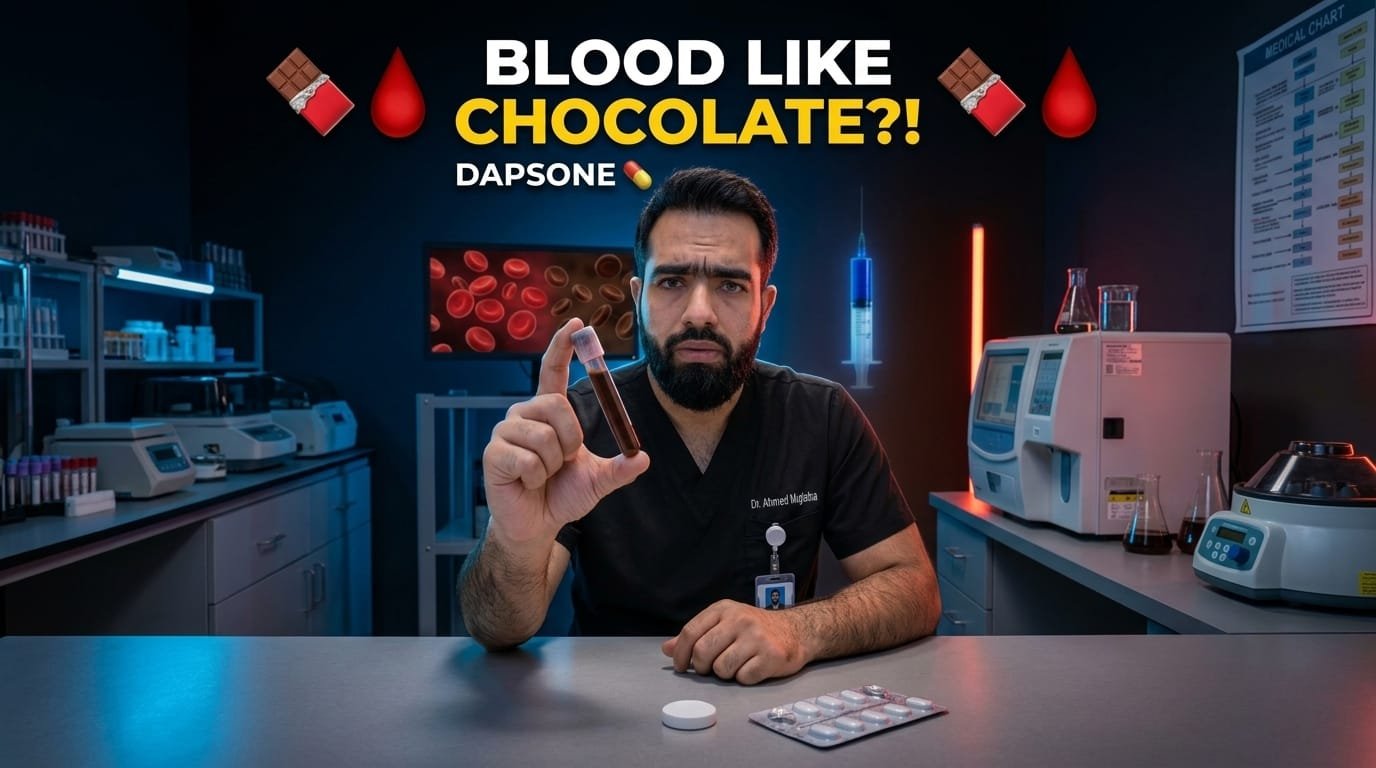
1. The Underlying Mechanism and Clinical Rationale
A patient may be short of breath, dizzy, weak, cyanotic, and have an unexpectedly low oxygen saturation.
But what if the lungs are actually receiving oxygen normally?
What if the real problem is inside the hemoglobin molecule itself?
This is where methemoglobinemia enters the story.
One important drug-associated cause is Dapsone, a medication used in several infectious and inflammatory conditions. Dapsone can cause oxidative stress and convert normal hemoglobin into methemoglobin, impairing effective oxygen transport and potentially causing tissue hypoxia.
This article explains dapsone-induced methemoglobinemia from basic pharmacology to advanced clinical concepts, including:
- What hemoglobin normally does
- What methemoglobin is
- Fe²⁺ versus Fe³⁺
- Why Dapsone causes methemoglobinemia
- The role of Dapsone hydroxylamine
- Why blood becomes chocolate brown
- Clinical symptoms
- Pulse oximetry and the saturation gap
- Co-oximetry
- G6PD deficiency
- Methylene blue mechanism
- Why methylene blue can be dangerous in G6PD deficiency
- Rebound methemoglobinemia
- Monitoring and clinical pearls
- Important differential diagnoses
Educational note: This article is intended for healthcare education. Suspected methemoglobinemia can be a medical emergency and requires appropriate clinical assessment and management.
Methemoglobinemia is a condition in which the iron within hemoglobin is oxidized from its normal ferrous (Fe²⁺) state to the ferric (Fe³⁺) state.
This oxidation produces methemoglobin.
The problem is that ferric iron cannot bind oxygen normally. In addition, the presence of methemoglobin alters the oxygen-binding behavior of the remaining normal hemoglobin, making oxygen release to tissues less effective.
Reduced oxygen delivery → tissue hypoxia.
Acquired methemoglobinemia is particularly important because it can occur after exposure to oxidizing drugs and chemicals.
- Dapsone
- Benzocaine
- Prilocaine
- Nitrates
- Nitrites
- Certain antimalarial drugs
- Aniline compounds
Dapsone is one of the recognized causes of acquired methemoglobinemia.
First Understand Normal Hemoglobin
Before understanding methemoglobinemia, we need to understand normal hemoglobin.
Hemoglobin is the major oxygen-carrying protein inside red blood cells.
A hemoglobin molecule consists of:
- Two alpha chains
- Two beta chains
- Four heme groups
Each heme group contains an iron atom.
That iron is critical for oxygen binding.
Under normal conditions, the iron is in the:
Ferrous state = Fe²⁺
This allows hemoglobin to participate in normal oxygen transport.
Hemoglobin + Fe²⁺ → functional oxygen transport
- What Happens When Fe²⁺ Becomes Fe³⁺?
Oxidative stress can remove an electron from the iron.
The resulting hemoglobin is called Methemoglobin.
The Fe³⁺ form cannot bind oxygen normally.
Normal hemoglobin → oxidation → methemoglobin → impaired oxygen transport
This is the fundamental mechanism behind methemoglobinemia.
Does Methemoglobin Normally Exist in the Body?
A small amount of hemoglobin is continuously oxidized during normal oxygen metabolism.
The body therefore has natural mechanisms to convert methemoglobin back toward functional hemoglobin.
The major physiological pathway involves Cytochrome b5 reductase.
This is also referred to as the NADH-dependent methemoglobin reductase pathway.
Under normal circumstances, this system continuously reduces methemoglobin and keeps its concentration low.
Methemoglobinemia develops when oxidation exceeds the body's ability to reduce methemoglobin.
The Two Important Redox Pathways:
For advanced students and healthcare professionals, it is useful to distinguish two pathways.
1. Major physiological pathway:
NADH → cytochrome b5 reductase → cytochrome b5 → methemoglobin reduction
This pathway operates continuously under normal physiological conditions.
2. Methylene-blue-associated pathway:
A second pathway becomes clinically important when methylene blue is administered.
NADPH → methylene blue → leukomethylene blue → methemoglobin reduction
This pathway depends on adequate NADPH availability.
And this is exactly why G6PD deficiency matters.
Why Does Dapsone Cause Methemoglobinemia?
Dapsone is a sulfone medication with antimicrobial and anti-inflammatory properties. It has established uses including treatment of leprosy and dermatitis herpetiformis, and it is also used in selected dermatologic and other clinical settings.
One important aspect of Dapsone pharmacology is its metabolism. Dapsone undergoes hepatic metabolism, including pathways that produce hydroxylamine metabolites.
One metabolite of particular importance is Dapsone hydroxylamine.
This metabolite contributes to oxidative stress and can promote oxidation of hemoglobin.
Dapsone → hydroxylamine metabolite → oxidative stress → hemoglobin oxidation → methemoglobin
This is the key pharmacological connection.
Why Does the Blood Become Chocolate Brown?
This is one of the most fascinating clinical clues.
Normally oxygenated blood appears bright red. When significant amounts of methemoglobin are present, blood can develop a characteristic dark chocolate-brown appearance. This occurs because of the optical properties of methemoglobin.
Cyanosis + low/abnormal oxygen saturation + chocolate-brown blood
Blood color alone does not confirm the diagnosis. Laboratory evaluation is required.
Why Can a Patient Be Hypoxic Even When the Lungs Are Working?
This is where students often get confused.
Suppose oxygen is entering the lungs normally. The lungs transfer oxygen into the blood.
So why is the patient still symptomatic?
Because oxygen transport is not only about oxygen entering the lungs. It also depends on functional hemoglobin. Methemoglobin reduces the effective oxygen-carrying capacity of hemoglobin.
Furthermore, oxidation of one heme group can alter the oxygen affinity of the remaining normal heme groups. The remaining normal hemoglobin tends to hold oxygen more tightly, shifting the oxygen dissociation curve toward the left. Therefore, oxygen delivery to tissues becomes impaired.
This explains why a patient can have significant symptoms even without primary pulmonary disease.
2. Pharmacological Dynamics and Patient-Specific Factors
- Clinical Features of Methemoglobinemia
Clinical presentation depends on several factors, including:
- Methemoglobin concentration
- Rate of formation
- Duration of exposure
- Patient's baseline hemoglobin
- Cardiopulmonary reserve
- Presence of other illnesses
Mild to moderate manifestations
- Cyanosis
- Headache
- Dizziness
- Fatigue
- Weakness
- Dyspnea
- Tachycardia
With significant tissue hypoxia, patients may develop:
- Confusion
- Altered mental status
- Metabolic acidosis
- Arrhythmias
- Seizures
- Coma
- Cardiovascular collapse
- Death
Clinical severity does not depend on the methemoglobin percentage alone; the patient's symptoms and underlying condition also matter.
Cyanosis That Does Not Respond Normally to Oxygen:
If a patient has cyanosis and conventional oxygen therapy does not produce the expected improvement, clinicians should consider abnormal hemoglobin species.
Methemoglobinemia is particularly important when there is a history of exposure to an oxidizing agent such as Dapsone.
Pulse Oximetry Can Be Misleading
This is an important point for medical and pharmacy students.
A pulse oximeter is not a direct measurement of all hemoglobin species. Traditional pulse oximeters use two wavelengths of light to estimate oxygen saturation. Methemoglobin interferes with this measurement.
As a result, patients with methemoglobinemia may show an oxygen saturation approaching the mid-80% range despite receiving oxygen. Do not automatically assume that every low SpO₂ represents a primary lung problem. when the clinical picture does not fit.
What Is the Saturation Gap?
It refers to an unexpected difference between pulse oximeter oxygen saturation and oxygen saturation calculated from arterial blood gas measurements.
A significant discrepancy can suggest abnormal hemoglobin species.
Saturation gap is a clue, not a definitive diagnosis.
The Best Laboratory Test: Co-Oximetry:
If methemoglobinemia is suspected, one of the most important diagnostic methods is Co-oximetry.
Co-oximetry uses multiple wavelengths to distinguish different hemoglobin species.
- Oxyhemoglobin
- Deoxyhemoglobin
- Carboxyhemoglobin
Therefore, co-oximetry can directly quantify the methemoglobin fraction.
- Methemoglobin
A blood gas with co-oximetry is therefore much more useful for confirming methemoglobinemia than relying on conventional pulse oximetry alone.
What Should You Ask in the Patient's Medication History?
When methemoglobinemia is suspected, medication history becomes extremely important.
Specifically consider oxidizing agents such as:
- Dapsone
- Benzocaine
- Prilocaine
- Nitrates/nitrites
- Certain antimalarial agents
In a patient taking Dapsone, unexplained cyanosis or dyspnea should immediately raise the possibility of "Dapsone-induced methemoglobinemia".
Dapsone-associated methemoglobinemia has been reported at therapeutic doses, emphasizing the importance of medication history.
G6PD Deficiency: Why Is It So Important?
Now we reach one of the most important advanced concepts.
G6PD = Glucose-6-phosphate dehydrogenase
G6PD is an important enzyme in the pentose phosphate pathway.
One of its major functions is generation of NADPH.
NADPH is essential for maintaining antioxidant defenses in red blood cells.
G6PD → NADPH → reduced glutathione → protection against oxidative stress
Red blood cells are particularly vulnerable to oxidative stress because mature RBCs lack mitochondria and have limited capacity to replace damaged cellular components.
What Happens in G6PD Deficiency?
Oxidative stress vulnerability ↑
This can predispose patients to oxidative hemolysis when exposed to certain drugs or other triggers.
Dapsone itself is recognized as a medication that can cause oxidative stress and hemolysis, particularly in susceptible patients.
Dapsone Can Cause More Than Methemoglobinemia:
When discussing Dapsone toxicity, do not focus only on methemoglobinemia.
Important adverse effects include:
- Hemolytic anemia
- Methemoglobinemia
- Agranulocytosis
- Aplastic anemia
- Hepatic injury
- Hypersensitivity reactions
- Peripheral neuropathy
Therefore, Dapsone therapy requires appropriate clinical and laboratory monitoring.
Treatment of Dapsone-Induced Methemoglobinemia:
Management depends on the severity of the condition. If Dapsone is responsible, clinicians should evaluate discontinuation of the drug.
Supplemental oxygen and appropriate cardiopulmonary support may be required. For clinically significant acquired methemoglobinemia, methylene blue is the principal antidotal treatment when appropriate.
- High-Yield Point: Monitor therapeutic response with standardized laboratory benchmarks.
- Risk Mitigation: Implement routine medication reconciliation to eliminate adverse drug events.
- Patient Empowerment: Communicate clear, jargon-free instructions to enhance therapy compliance.
3. Practical Clinical Applications and Safety Guidelines
- How Does Methylene Blue Work?
This is one of the most important pharmacology mechanisms to understand.
Methylene blue provides an alternative pathway for reducing methemoglobin.
Methemoglobin Fe³⁺ → Hemoglobin Fe²⁺
The reduced form, leukomethylene blue, acts as an electron donor that facilitates reduction of methemoglobin.
Therefore, methylene blue essentially helps the body accelerate the conversion of oxidized hemoglobin back toward its functional form.
Why Is G6PD Deficiency a Major Problem With Methylene Blue?
Now connect the two pathways. Methylene Blue requires NADPH and NADPH production in RBCs depends heavily on G6PD activity.
There is another concern.
Methylene blue itself can have oxidant effects and can increase the risk of hemolysis in patients with G6PD deficiency.
The FDA prescribing information for PROVAYBLUE specifically lists G6PD deficiency as a contraindication because of the risk of hemolytic anemia.
What Does the FDA Label Say About Methylene Blue?
The FDA-approved prescribing information for PROVAYBLUE states that it is indicated for acquired methemoglobinemia in adults and pediatric patients. The labeled dose is 1 mg/kg IV over 5-30 minutes.
If methemoglobin remains above 30% or clinical signs and symptoms persist, another 1 mg/kg dose may be given one hour after the initial dose.
The label specifically contraindicates use in patients with G6PD deficiency because of the risk of hemolytic anemia. Clinical decisions should always follow the current product labeling and institutional toxicology/emergency protocols.
Why Can Dapsone Cause Rebound Methemoglobinemia?
Dapsone has pharmacokinetic characteristics that can allow prolonged exposure. After initial treatment with methylene blue, methemoglobin can rise again in some Dapsone-related cases.
The possibility of recurrence is particularly important with Dapsone because ongoing drug/metabolite exposure can continue to drive oxidation. Therefore, a patient may initially improve and later develop recurrent methemoglobinemia.
Published case literature describes recurrent methemoglobin elevation following Dapsone exposure. This is one reason monitoring should not stop immediately after the first apparent improvement.
What If Methylene Blue Cannot Be Used?
When methylene blue is contraindicated or ineffective, management becomes more complex.
Depending on the clinical situation, specialists may consider alternatives such as:
- Supportive oxygen therapy
- Ascorbic acid
- Exchange transfusion
- Hyperbaric oxygen in selected severe cases
Evidence and clinical experience vary for alternative treatments, and management should be individualized with appropriate toxicology or critical-care input.
Important Differential Diagnoses:
Not every cyanotic patient has methemoglobinemia.
- Pneumonia
- Pulmonary edema
- Pulmonary embolism
- Severe airway disease
- Cyanotic congenital heart disease
- Severe cardiac dysfunction
- Carboxyhemoglobinemia
- Sulfhemoglobinemia
- Benzocaine
- Prilocaine
- Nitrates/nitrites
- Dapsone
- Other oxidizing agents
The medication and exposure history can therefore be extremely valuable.
Dapsone Monitoring: What Should Healthcare Professionals Remember?
For patients receiving oral Dapsone, baseline evaluation commonly includes:
- Complete blood count
- Differential count
- Liver function tests
- Renal function tests
- G6PD testing
- Appropriate clinical assessment
Follow-up monitoring may include repeated CBCs and assessment of liver and renal function, with methemoglobin measurement when clinically indicated.
Monitoring requirements can vary depending on indication, formulation, patient characteristics and institutional protocols.
A Clinical Case to Put Everything Together:
Several days or weeks later, the patient develops:
- Headache
- Weakness
- Shortness of breath
- Cyanosis
Pulse oximetry shows an unexpectedly low reading.
The patient receives oxygen, but the clinical picture does not improve as expected.
Now think through the pharmacology.
Cyanosis + neurological/respiratory symptoms
If clinically significant acquired methemoglobinemia is present, treatment may include removal of the offending agent, supportive care and, when appropriate, methylene blue.
But if significant G6PD deficiency is present:
Methylene blue is contraindicated according to the FDA label.
Key Clinical Takeaways
- Dapsone-Induced Methemoglobinemia: Chocolate-Brown Blood, Mechanism, Symptoms, Diagnosis and Treatment requires thorough evaluation of biological mechanisms and individualized patient risk factors.
- Therapeutic monitoring and proactive adverse effect mitigation are essential for optimizing treatment outcomes.
- Interprofessional collaboration between physicians, clinical pharmacists, and nursing staff enhances patient safety.
- Educating patients with simplified, transparent healthcare knowledge improves long-term medication compliance.
Frequently Asked Questions
Why is understanding Dapsone-Induced Methemoglobinemia: Chocolate-Brown Blood, Mechanism, Symptoms, Diagnosis and Treatment critical for healthcare providers and patients?
Clear comprehension of pharmacological pathways and clinical guidelines enables safer prescribing, minimizes preventable adverse drug events, and ensures patients understand the purpose and safety of their therapy.
What are the primary clinical monitoring parameters for this therapy?
Clinicians should assess baseline renal and hepatic function, evaluate potential cytochrome P450 drug interactions, and schedule regular follow-ups to track symptom resolution and laboratory biomarkers.
How does Dr. Ahmed Mujtaba approach patient education for this topic?
By breaking down complex molecular mechanisms into intuitive visual analogies and clear clinical pearls, patients gain confidence and active agency in their healthcare journey.
Why does Dapsone cause chocolate-brown blood?
Dapsone can increase oxidative stress and promote formation of methemoglobin. Increased methemoglobin produces the characteristic dark chocolate-brown appearance of blood.
Can methylene blue be used in G6PD deficiency?
According to the FDA prescribing information for PROVAYBLUE, methylene blue is contraindicated in patients with G6PD deficiency because of the risk of hemolytic anemia.